 Skip to content

Soil Moisture Sensors for Irrigation: 7 Proven Tips for Commercial Lawns in Pakistan
Summary: Soil moisture sensors for irrigation measure water at root depth and tell an IoT controller when to open or close automatic irrigation valves. On commercial lawns, this replaces fixed timers with data-driven watering, which cuts water waste, turf stress and manual supervision.
Soil moisture sensors for irrigation give commercial lawns something a timer never can: live proof of what the root zone needs. If you manage a society park, hotel lawn or large estate, you already know what a wrong schedule costs. Overwatering in June rots roots and inflates tubewell bills, while one missed cycle in 45°C heat can scorch turf within days.
Facility managers in Pakistan keep asking the same questions. Will sensors survive heat and dust? Do they work with salty bore water and load shedding? Is the investment actually recovered?
Since 2013, Design & Concept Studio has designed and built lawns, parks and estates across DHA Karachi, DHA Gujranwala, Bahria Town and Dera Ismail Khan. This guide shares the seven practices we apply when specifying soil moisture sensors for irrigation on commercial sites.
What Are Soil Moisture Sensors for Irrigation?
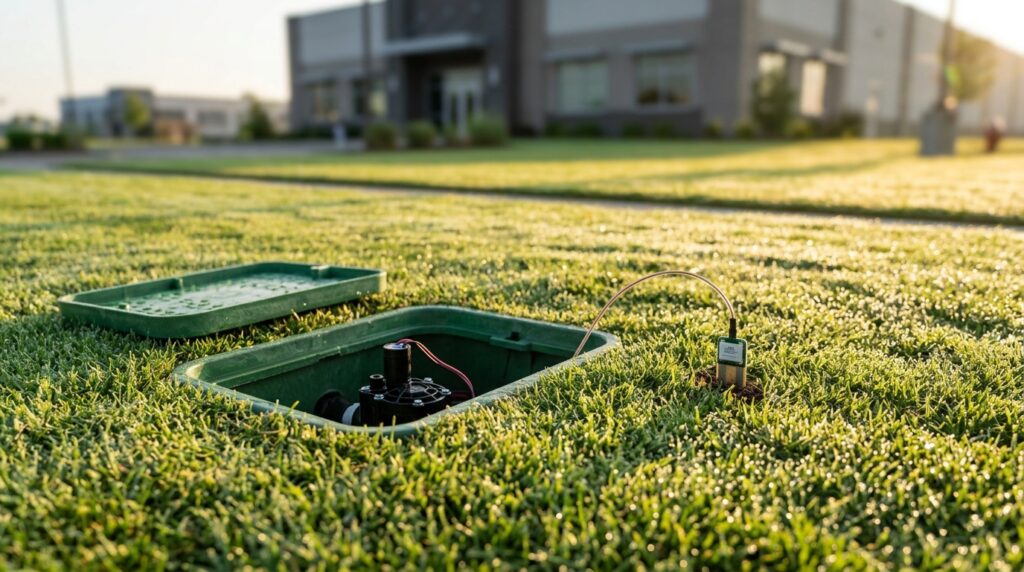
A soil moisture sensor measures the water content around its probes and sends that reading to an irrigation controller. The controller compares it with your set thresholds and decides whether to water.
Most turf sensors sit 10 to 15 cm deep, inside the active root zone. When moisture falls below the lower threshold, the zone’s solenoid valve opens. When it reaches the upper threshold, the valve closes.
This logic is the core of any smart irrigation system. A timer waters because the clock says so. Soil moisture sensors for irrigation water because the soil asks for it.
How an IoT Irrigation System Uses Soil Moisture Sensors for Irrigation
An IoT irrigation system links field sensors, a smart controller and automatic irrigation valves through wired or wireless communication. Data reaches a mobile app or dashboard for remote monitoring.
The standard chain has four layers:
- Sensors: Soil moisture, plus optional rain sensors and flow sensors
- Controller: The irrigation controller that applies thresholds and weather data
- Actuators: Solenoid valves that open and close each zone
- Interface: A mobile app or web dashboard for real-time monitoring and alerts
Connectivity can be hardwired cable for compact sites, LoRa-type radio for large campuses, or GSM/4G for remote control. For irrigation automation in Pakistan, choose a controller that keeps running on local logic when the network drops.
⚙️ What We Learned in the Field: Most “smart system” complaints come from signal dependence. A controller that stores schedules and thresholds locally keeps watering correctly even when the internet fails.
Why Timer-Based Commercial Lawn Irrigation Fails
Fixed schedules ignore rain, humidity, shade and soil differences. They overwater in some weeks and underwater in others.
Timers are usually set once for peak summer and rarely adjusted. After a monsoon downpour, the system keeps running. In sandy soils, the opposite happens: water drains below the roots before the grass can use it.
- Overwatering: Waterlogged soil, fungal patches and higher pumping costs
- Underwatering: Brown strips, thin turf and expensive re-sodding
- Labor dependence: A gardener has to judge moisture by eye or by hand
⚠️ Common Client Mistake: Setting the timer for the hottest week of the year and leaving it unchanged through winter. Sensors remove this seasonal drift automatically.
7 Proven Tips for Installing Soil Moisture Sensors for Irrigation
Good results come from sensor choice, zoning, placement, valve integration, thresholds, local-condition design and maintenance. Skip any one of these and the system underperforms.
Tip 1: Choose the Right Sensor Type
Capacitive and TDR/FDR sensors suit most commercial lawns. Resistive probes are cheap but corrode quickly, especially in saline soil.
| Sensor Type | Accuracy | Durability in Pakistan | Best Use |
|---|---|---|---|
| Resistive probe | Low to moderate | Poor, corrodes in saline soil | Short trials only |
| Capacitive | Good | Good, if sealed and coated | Most commercial lawn zones |
| TDR / FDR professional | High | Very good | Large estates, parks, sports turf |
| Tensiometer | High (soil tension) | Needs regular servicing | Specialist turf, research sites |
🛠️ Professional Tip: Ask every vendor whether the sensor compensates for soil salinity and temperature. A vague answer usually means drifting readings by the second summer.
Tip 2: Divide the Lawn into Hydrozones
A hydrozone is an area with similar sun exposure, soil and grass type. Each hydrozone needs its own soil moisture sensors for irrigation and its own valve.
One sensor in a shaded corner will starve the full-sun strip next to it. Zone the lawn first, then specify hardware.
Tip 3: Place Soil Moisture Sensors for Irrigation at Root Depth
Place the sensor at 10 to 15 cm, midway between two sprinkler heads, where coverage is average. Keep it at least 1 to 2 meters from paths, edges and walls.
On large zones, install two sensors and average their readings. This protects you from a single bad data point.
💡 Our Experience: Sensors placed right beside a sprinkler head read “wet” all day and keep the zone switched off. Moving them to the head-to-head midpoint usually fixes this.
Tip 4: Connect Sensors to Automatic Irrigation Valves
Automatic irrigation valves are solenoid-operated and open on a low-voltage signal from the controller, usually 24V AC or latching DC. Each zone gets its own valve in a protected box.
- Latching solenoids: Low power draw, ideal for solar or battery setups
- Standard solenoids: Reliable where mains power is stable
- Filtration: Mandatory upstream of valves in sediment-heavy tubewell water
Add a flow sensor to detect pipe bursts or stuck valves. If actual flow differs from expected flow, the controller can shut the main line.
Tip 5: Set Moisture Thresholds and Irrigation Scheduling
Set a lower threshold that triggers watering and an upper one that stops it. Sandy soil needs a higher trigger and shorter, more frequent cycles, while clay soil needs deeper, less frequent watering.
Start with conservative values and adjust after two weeks of logged data. Add a rain sensor or weather feed so that monsoon days suspend irrigation. Early-morning watering windows reduce evaporation further.
Tip 6: Design for Heat, Salinity and Load Shedding
Soil moisture sensors for irrigation in Pakistan must handle 45°C+ heat, dust, saline water and unstable power. Most early failures trace back to ignoring one of these.
| Challenge | Design Response |
|---|---|
| Extreme heat | UV-resistant enclosures, shaded controller cabinet |
| Saline or hard bore water | Salinity-compensated sensors, filtration, scheduled flushing |
| Load shedding | Battery or solar backup, latching solenoids |
| Monsoon flooding | Raised, waterproof valve and controller housings |
| Weak mobile signal | Controller with offline local logic |
| Rodent and cable damage | Conduit-protected, buried cabling |
🛠️ Professional Tip: Mount the controller in a ventilated, shaded, lockable cabinet. Direct sun on an electronics box is a quiet killer of smart systems.
Tip 7: Maintain on a Calendar
Smart systems need less labor, not zero maintenance. Soil moisture sensors for irrigation stay accurate only when they are checked and recalibrated.
- Monthly: Review the dashboard for abnormal zones and flow alerts
- Quarterly: Clean filters, inspect valve boxes, verify sensor readings against a manual probe
- Annually: Recalibrate sensors, update firmware, inspect cabling before summer
🎥 Video slot: Embed a 2 to 3 minute site video here showing sensor installation and the dashboard in action. Title it “How Soil Moisture Sensors for Irrigation Work on a Commercial Lawn.”
Cost and Payback of Soil Moisture Sensors for Irrigation
Sensor-based control reduces water use compared with fixed timers, and the savings depend on how much you overwater today. Returns are strongest on large lawns with pumped water and high electricity costs.
Industry sources commonly report savings in the 20 to 40 percent range. We do not promise a fixed number. We calculate it per site after a survey.
A simple payback logic you can run yourself:
- Estimate current monthly pump hours and electricity or diesel cost
- Estimate the reduction from removing unneeded cycles
- Add savings from lower turf replacement and labor
- Compare the total against the system quote
System cost varies with zone count, sensor grade, valve count and connectivity. Any “standard price” for soil moisture sensors for irrigation quoted online without a site survey is unreliable.
Common Myths About Smart Irrigation
Smart irrigation does not fix bad lawn design. It works best on top of correct grading, drainage and plant selection.
- Myth: “One sensor can control the whole lawn.” Reality: Every hydrozone needs its own.
- Myth: “Sensors fix poor drainage.” Reality: They report moisture. They cannot repair compacted soil or poor grading.
- Myth: “Cheap hobby sensors are fine for commercial sites.” Reality: Low-grade probes drift and corrode within a season.
- Myth: “A smart system is maintenance-free.” Reality: It reduces routine labor, but it still needs servicing.
FAQs on Soil Moisture Sensors for Irrigation
How do soil moisture sensors for irrigation work?
They measure water content in the root zone and send readings to a controller. When moisture falls below a set threshold, the controller opens the zone’s valve, and closes it at the upper threshold.
How many sensors does a commercial lawn need?
Plan at least one per hydrozone. Large or variable zones benefit from two sensors with averaged readings.
Will a smart irrigation system work during load shedding or poor internet?
Yes, if it is designed for it. Use a controller with local logic, latching solenoid valves and battery or solar backup.
Does saline bore water affect soil moisture sensors?
Yes. Salts can distort readings on low-grade sensors. Choose salinity-compensated sensors, filter the water and recalibrate regularly.
Plan Your Smart Irrigation System with Design & Concept Studio
Start with a site survey covering soil, water source, zones and power. Then specify sensors, valves and controllers to match.
Our team integrates irrigation with soft-landscape, hard-landscape and waterscape design, so the system is planned with the site and not retrofitted later. To discuss your commercial lawn, contact Design & Concept Studio.


