Skip to content
Native vs Exotic Plants Pakistan: A Field-Tested Framework for Choosing the Right Species
Summary: For most Pakistani gardens, native and regionally naturalized species should form the structural backbone of the landscape, while non-invasive exotics are reserved for accent planting where their higher water and maintenance cost is justified by a specific design goal. Design & Concept Studio applies this hybrid framework across every project, matching species choice to site soil, water access, and long-term maintenance budget rather than trend alone.
The Real Cost of Getting This Choice Wrong
If your second-year maintenance bill is higher than your first-year planting bill, you’re not imagining it you likely have too many high-input exotic species in a landscape that was never budgeted to support them.
This is one of the most common regrets we hear from clients across DHA, Bahria Town, and private estates: a landscape that looked stunning at handover, then became a recurring pesticide, fertilizer, and replacement expense within eighteen months.
The native vs exotic plants Pakistan debate isn’t ideological it’s a practical design decision with measurable cost, water, and survival consequences. This guide breaks down exactly how to choose, using the same framework we apply on every Design & Concept Studio project across 13 years of field data.
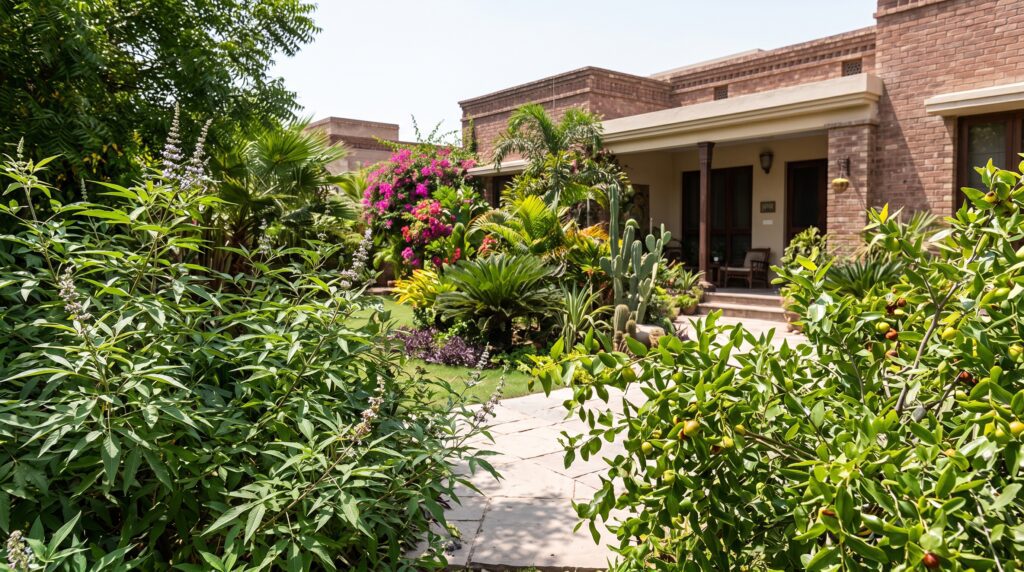
💡 Our Experience: On a Bahria Town estate project, a client’s previous designer had specified an all-exotic hedge and lawn palette. Within one year, over 30% of the hedge required replacement. We rebuilt the same visual density using native Vitex and naturalized Bougainvillea at roughly half the ongoing input cost.
What “Native” and “Exotic” Actually Mean in a Pakistani Context
BLUF: A native plant evolved in Pakistan’s regional ecosystems over long timescales, while an exotic plant was introduced from elsewhere and the distinction matters most where an introduced species also becomes invasive.
- Native / Indigenous species: Evolved locally, adapted to regional soil, rainfall, and pest pressure without human intervention. Examples: Jand (Prosopis cineraria), Ber (Ziziphus mauritiana), Neem (Azadirachta indica), Vitex negundo.
- Introduced / Exotic species: Brought from other regions or countries, often for ornamental or agricultural purposes. Examples: Ficus benjamina, Washingtonia palms, many imported turf grass cultivars.
- Invasive exotic species: A smaller subset of exotics that spread aggressively beyond planted areas, displacing native vegetation. Example: Prosopis juliflora (Vilayati Babul).
⚠️ Common Client Mistake: Confusing Prosopis juliflora (an invasive exotic, locally called Vilayati Babul) with Prosopis cineraria (Jand, a valuable native tree). They look superficially similar to a non-specialist, but one is a landscape asset and the other is an ecological liability. This mix-up appears constantly in casual gardening advice online.
Native Plants: Strengths and Trade-Offs
BLUF: Native species generally require less water, resist local pests better, and support local wildlife but their design flexibility can be narrower than exotics for highly stylized, non-regional aesthetics.
Strengths
- Lower water requirements: Adapted to regional rainfall patterns and dry-season stress over generations.
- Higher pest and disease resistance: Co-evolved with local insect and fungal populations, reducing pesticide dependency.
- Stronger ecological value: Support local pollinators, birds, and beneficial insects that exotic ornamentals often can’t sustain.
- Lower long-term maintenance cost: Less fertilizer, less pest treatment, fewer replacement cycles.
Trade-Offs
- Fewer “instant impact” options for clients wanting an immediately dense, uniform hedge look.
- Some native species have a slower initial growth rate than fast-growing exotics.
- Sourcing quality native nursery stock can be harder than sourcing common imported ornamentals.
Exotic Plants: Strengths and Trade-Offs
BLUF: Exotic species can offer specific colors, forms, or rapid screening effects unavailable in native plant lists, but usually at a real cost in water, pest management, and long-term reliability.
Strengths
- Design variety: Many popular ornamental colors, leaf shapes, and forms are exotic in origin.
- Rapid initial growth: Several exotic hedge and shade species establish visual density faster than natives.
- Market familiarity: Widely available at most local nurseries, simplifying sourcing.
Trade-Offs
- Higher irrigation demand, often unsuited to Pakistan’s dry-season water access in DHA, Bahria Town, and rural estate sites.
- Greater pest and disease vulnerability, since local pest populations have no natural predator balance against them.
- Invasive risk in specific species, which can escape managed beds and spread into surrounding land or waterways.
⚙️ What We Learned in the Field: Washingtonia palms look striking in renderings, but on multiple estate sites we’ve serviced, they required significantly more irrigation scheduling attention than clients expected from a “low-maintenance” palm recommendation elsewhere.
Decision Matrix: Native vs Exotic Plants Pakistan Landscapes
BLUF: Scoring each option against water need, pest resistance, ecological value, and design flexibility gives a clearer answer than “native good, exotic bad” the right mix depends on the specific bed’s purpose.
| Factor | Native Plants | Exotic Plants |
|---|---|---|
| Water requirement | Low to moderate | Moderate to high |
| Pest/disease resistance | High | Variable, often lower |
| Ecological/pollinator value | High | Low to moderate |
| Initial visual impact | Moderate | Often high |
| Long-term maintenance cost | Low | Moderate to high |
| Invasive risk (specific species) | Very low | Present in a defined subset |
The Hybrid Palette: How Professional Designers Actually Choose
BLUF: The strongest Pakistani landscapes use native species as the structural, high-coverage backbone and reserve selected non-invasive exotics as accent planting in focal points.
- Structural layer (70-80% of planting): Native trees and shrubs Jand, Ber, Neem, Vitex, Kaner forming the backbone that survives with minimal input.
- Accent layer (20-30% of planting): Carefully chosen non-invasive exotics placed at entries, focal beds, or feature walls where higher water and maintenance investment is justified by visibility.
- Excluded entirely: Species with documented invasive behavior in Pakistan, such as Prosopis juliflora, regardless of how established they are in the local market.
🛠️ Professional Tip: Ask any nursery or designer to confirm the botanical name of a proposed species, not just the local nickname. Several invasive exotics carry the same colloquial names as valuable natives, which is exactly how confused planting decisions happen at scale.
Ecological Value: Why It Belongs in a Design Conversation, Not Just a Biology Class
BLUF: Native plants support pollinators, birds, and beneficial insects that keep pest populations in check naturally a functional landscaping benefit, not just an environmental one.
Commercial parks and large estate master plans benefit directly from this. A planting palette that supports local pollinators reduces the need for chemical pest intervention across the entire site, not just in the native beds themselves.
💡 Our Experience: On commercial park and master-planning projects, we’ve observed measurably fewer pest outbreaks in mixed native/exotic sections compared to all-exotic ornamental sections planted in the same season under the same irrigation schedule.
How Design & Concept Studio Builds Your Native/Exotic Plant Strategy
BLUF: We build every plant palette from a site-specific soil, water-access, and maintenance-budget assessment first, then select the native-to-exotic ratio that fits your actual site rather than a generic trend list.
Our process starts with understanding your water access reality municipal supply, tanker dependency, or borewell before a single species is proposed. From there, we build a native-backbone, exotic-accent palette matched to your budget for ongoing maintenance, not just initial installation.
If you’re planning a new landscape, renovating an existing one, or building a master plan for a commercial or park site, our team can assess your property and build a planting strategy engineered for your specific conditions.