 Skip to content

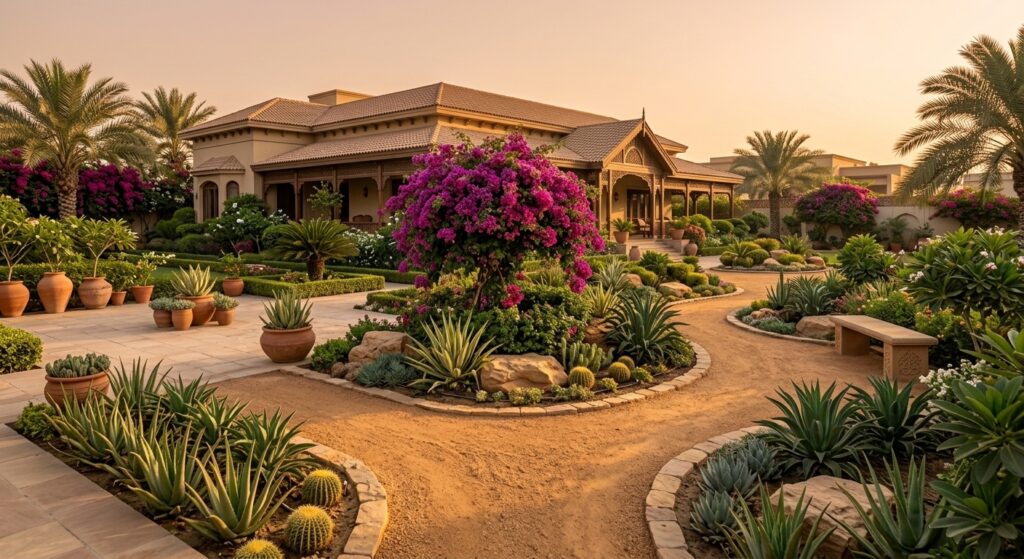
Xeriscaping Pakistan: 5 Water-Saving Principles: How to Cut Water Usage Without Losing Curb Appeal
Summary: Xeriscaping Pakistan5 Water-Saving Principles means designing landscapes around hydrozoning, native and drought-tolerant plant selection, soil correction, and drip irrigation to cut outdoor water use by up to 60%. Done correctly by an experienced design team, it produces a resilient, attractive garden not a gravel-and-cactus compromise.
Your Water Bill Isn’t Lying to You
If your garden is draining your tanker budget faster than it’s growing, you are not alone. Homeowners across DHA Karachi, Bahria Town, and Gujranwala are facing the same reality: traditional lawns and imported ornamental plants were never designed for Pakistan’s arid and semi-arid climate zones.
Xeriscaping Pakistan is the engineering-led answer to this problem a landscape design approach that reduces water dependency without turning your property into a bare rock yard. It’s a method, not a style restriction.
At Design & Concept Studio, we’ve spent 13+ years solving exactly this problem across elite private estates and commercial developments nationwide, backed by our full master planning and soft-landscape architecture services. We’ve watched clients get burned by “low maintenance” promises from contractors who never tested the soil or accounted for monsoon runoff. This guide fixes that gap.
What Is Xeriscaping, and Why Pakistan Needs a Local Approach
Xeriscaping Pakistan: 5 Water-Saving Principles is a water-conservation landscaping method built on soil health, hydrozoning, and drought-adapted plant selection. In Pakistan, it must also account for saline soils, borewell dependency, and short but intense monsoon downpours factors most generic xeriscaping guides ignore entirely.
Most content on Xeriscaping Pakistan: 5 Water-Saving Principles is lifted from US or Australian sources where climate, soil chemistry, and rainfall patterns are completely different. That mismatch is why so many homeowners try a “drought tolerant” plant list and still watch it die within a season.
⚠️ Common Client Mistake: Buying drought-tolerant plants online without testing local soil salinity first. In coastal Karachi properties especially, the plant isn’t the problem the soil chemistry is killing the roots before the plant even gets a chance to establish.
According to WaterSense, the U.S. EPA’s water-efficiency program, a well-designed water-smart landscape can cut outdoor water use significantly while still delivering strong curb appeal the same principle applies in Pakistan, just with a different soil and rainfall baseline.
A locally engineered xeriscape design the kind we build through our hard-landscape engineering process accounts for three regional realities:
- Soil salinity and compaction: especially in reclaimed coastal land and older Punjab developments.
- Bi-modal water stress: long dry stretches punctuated by short, heavy monsoon bursts that cause runoff if grading isn’t handled correctly.
- Tanker and borewell dependency: which changes the economics of irrigation system design compared to municipal-water markets abroad.
Step 1: Soil Diagnostics Before Any Plant Selection
Correct soil chemistry and drainage before choosing a single plant. Skipping this step is the single biggest reason water saving landscaping projects fail in Pakistan within the first year.
Soil in Pakistan varies dramatically by region, and generic advice fails because of it.
| Region | Common Soil Issue | Impact on Xeriscaping | Correction Method |
|---|---|---|---|
| Coastal Karachi (DHA City) | High salinity, poor drainage | Root burn, stunted growth | Gypsum treatment, raised planting beds |
| Punjab (Gujranwala, Bahria Town) | Calcareous, compacted clay | Poor water penetration | Deep aeration, organic matter integration |
| Northern semi-arid (DI Khan) | Sandy, low organic content | Rapid moisture loss | Compost amendment, mulching |
⚙️ What We Learned in the Field: On a DHA City Karachi estate, a client’s previous contractor planted drought-tolerant shrubs directly into unamended saline fill soil. Every plant failed within four months. We re-graded, added gypsum and organic compost, and the replanted zone has thrived for three years with 40% less irrigation.
Water quality and groundwater conditions vary sharply by region, which is why we also reference data from the Pakistan Council of Research in Water Resources (PCRWR) when scoping soil and irrigation plans for new sites.
Soil correction checklist for xeriscape garden Pakistan projects:
- Test salinity and pH before design finalization, not after installation.
- Add organic matter (compost, aged manure) to improve water retention in sandy soils.
- Break compaction in clay-heavy Punjab soils through mechanical aeration.
- Grade for drainage so monsoon runoff doesn’t pool against foundations or root zones.
Hydrozoning The Core Engineering Principle
Hydrozoning groups plants by water requirement into distinct zones, so you never over-water drought-tolerant species or under-water focal ornamentals. This single design step is what separates professional water efficient landscaping Pakistan projects from amateur plant-swap jobs.
Most local competitors skip this step entirely and simply list plants. That’s a design failure waiting to happen.
Our standard 4-zone model, adapted for typical DHA and Bahria Town plot sizes and applied through our master planning service:
- Zone 1 High Visibility, Moderate Water: Entrance beds and focal points near seating areas. Ornamental but efficient species.
- Zone 2 Native & Drought Tolerant: Perimeter beds, side yards. Indigenous and low-water shrubs requiring minimal supplemental irrigation once established.
- Zone 3 Hardscape Transition: Gravel, decomposed granite, or permeable paving paths that need zero irrigation and double as monsoon drainage channels.
- Zone 4 Utility/Low Priority: Rear boundary or service areas planted with the hardiest, lowest-maintenance species available.
💡 Our Experience: Clients almost always want to over-plant Zone 1 with imported ornamentals. We let them but we cap it at 15-20% of total landscape area, so the water budget stays controlled while curb appeal stays intact.
Step 3: Drought-Tolerant and Native Plant Selection
Native and regionally adapted species outperform imported ornamentals on water efficiency, disease resistance, and long-term cost. A well-designed drought tolerant landscaping Pakistan palette can still deliver full color and texture year-round.
Species we specify regularly across our project portfolio:
- Bougainvillea: thrives on minimal water once established, high color impact for Zone 1.
- Conocarpus (where regionally appropriate): fast establishing screen planting, though we advise site-specific evaluation given ongoing regional debate on its water table impact.
- Lantana camara: extremely low water, continuous flowering, excellent Zone 2 filler.
- Vinca (Sadabahar): heat tolerant, ideal groundcover for exposed beds.
- Neem and Sheesham: indigenous shade trees with deep root systems that reduce surface irrigation dependency.
- Aloe Vera and Agave varieties: near-zero water requirement, strong structural accents for Zone 3 transitions.
🛠️ Professional Tip: Mix textures, not just species. A monoculture of one drought-tolerant plant still reads as “sparse.” Layering groundcover, mid-height shrubs, and vertical accents creates the lush look clients want with the water discipline the climate demands.
All species referenced above are sourced through our own direct plants supply and nurseries network, which lets us guarantee stock health and regional acclimatization before planting.
Step 4: Efficient Irrigation Design for Tanker-Dependent Properties
Drip irrigation, not sprinklers, is the backbone of effective low water landscaping in Pakistan especially where households rely on tankers or borewells rather than steady municipal supply.
Sprinkler systems lose 30-50% of water to evaporation and overspray. Drip systems deliver water directly to the root zone, cutting waste dramatically a principle detailed in the EPA’s water-smart landscape design guidance, which we adapt for tanker and borewell-fed properties rather than municipal supply. This is core to our waterscape architecture practice.
Tanker cost comparison illustrative Karachi scenario:
| Irrigation Method | Estimated Monthly Water Use | Relative Tanker Cost Impact |
|---|---|---|
| Traditional lawn + sprinkler | High | Highest frequent tanker refills |
| Mixed ornamental beds, hand watering | Moderate-High | Elevated, inconsistent |
| Xeriscape design + drip irrigation | Low | Significantly reduced, more predictable |
⚙️ What We Learned in the Field: On a Bahria Town residential project, converting from manual hose watering to a gravity-assisted drip system cut the client’s weekly tanker orders by roughly half within the first two irrigation cycles post-establishment.
Irrigation design essentials:
- Low-pressure drip lines: that function even during power cuts, using gravity-fed header tanks where needed.
- Mulching: every planting bed to reduce evaporation and suppress weeds.
- Timer-based scheduling: for early morning or late evening watering to minimize evapotranspiration loss.
- Rainwater harvesting: catchment from rooftops and hardscape surfaces to offset dry-season irrigation demand.
Step 5: Designing for Monsoon Runoff, Not Just Drought
A true Xeriscaping Pakistan: 5 Water-Saving Principles must handle two extremes long dry spells and short, intense monsoon downpours. Ignoring runoff grading is the gap most sustainable landscaping Pakistan content overlooks entirely.
Gravel and permeable paving in Zone 3 aren’t just aesthetic they’re functional drainage infrastructure. Properly graded xeriscapes direct monsoon runoff toward planting beds instead of away from them, effectively “banking” seasonal rainfall for dry-season use.
⚠️ Common Client Mistake: Flat grading with no runoff channels. During monsoon season, this causes pooling that drowns drought-adapted root systems that are simply not built for standing water undoing months of water-saving design in a single storm.
Long-Term Maintenance: What “Low Water” Really Means
Xeriscaping Pakistan: 5 Water-Saving Principles reduces water and long-term maintenance costs, but it is not a zero-maintenance system especially in the first 12-18 months of plant establishment.
- Establishment phase (Year 1): Regular deep watering is still required to develop drought-resistant root systems. Cutting water too early kills plants that would otherwise thrive long-term.
- Mature phase (Year 2+): Watering frequency drops significantly; maintenance shifts to pruning, mulch replenishment, and seasonal bed edging.
- Ongoing soil health: Annual organic matter top-up keeps water retention performing at design specification.
If your property’s water demand, soil condition, or drainage grading needs a professional assessment before you commit to a redesign, get in touch with our design team we scope every xeriscape project on-site, not off a plant catalog.

