Skip to content
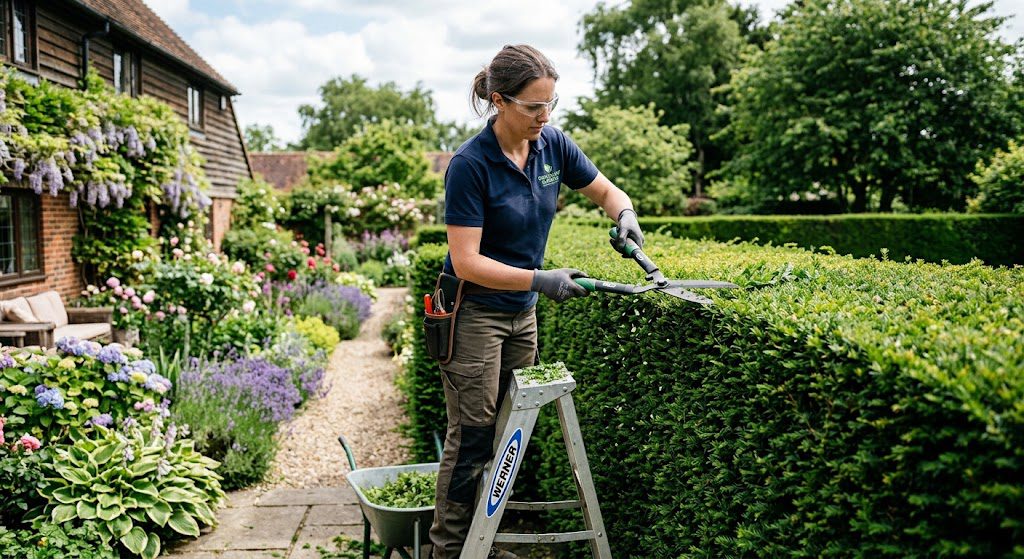
Professional Hedge Trimming & Garden Pruning Services
Summary: Hedge trimming services should protect plant health and long-term shape development, not just deliver a tidy look for a day. Correct timing, technique, and understanding the difference between formative and maintenance pruning determine whether a hedge stays healthy and dense for years, or thins out and declines from repeated incorrect cuts.
Pruning Is Plant Health Management, Not Just Tidying
Hedge trimming services are often thought of as purely cosmetic a way to keep a garden looking neat. In practice, how and when a hedge or shrub is pruned directly affects its long-term health, density, and even its ability to flower or fruit properly.
Incorrect pruning timing, technique, or frequency is one of the more common causes of thinning, patchy, or declining hedges we see on properties that previously relied on informal or inconsistent garden maintenance. Professional hedge trimming services treat pruning as ongoing plant health management, not a once-a-season tidy-up.
This guide covers what actually goes into professional hedge trimming and garden pruning timing, technique, and the difference between shaping a young hedge and maintaining an established one.
Formative vs. Maintenance Pruning: A Key Distinction
Summary: Formative pruning shapes a young hedge or shrub’s structure early in its growth, while maintenance pruning preserves an already-established shape and manages ongoing plant health. Treating a young hedge with maintenance-level pruning, or an established hedge with aggressive formative cuts, both lead to poor long-term results.
Formative Pruning
Applied to young hedges and shrubs to establish density and shape early more deliberate and structural than routine trimming, setting the foundation for how the plant will develop over years.
Maintenance Pruning
Applied to established hedges to preserve shape, remove deadwood, and encourage continued healthy density regular, lighter trimming rather than significant structural cuts.
⚠️ Common Client Mistake: Property owners sometimes apply the same trimming approach to a young hedge that they’d use on a mature one light, infrequent trimming that doesn’t actually encourage the dense, structured growth a young hedge needs to develop properly. Formative and maintenance pruning genuinely require different approaches.
Why Pruning Timing Matters for Plant Health
Summary: Pruning at the wrong point in a plant’s growth cycle can reduce flowering, stress the plant, or encourage weaker regrowth timing needs to match the specific plant type’s growth and flowering pattern, not a single generic schedule. This is one of the most commonly overlooked factors in DIY hedge maintenance.
- Flowering shrubs often need pruning timed around their specific bloom cycle pruning at the wrong point can remove the growth that would have flowered.
- Evergreen hedges generally tolerate more frequent trimming but still benefit from avoiding pruning during periods of active new growth stress, such as extreme heat.
- Deadwood removal can generally happen any time it’s identified, since removing dead material doesn’t carry the same timing sensitivity as shaping cuts.
💡 Our Experience: On garden maintenance programs across DHA and Bahria Town developments, we’ve seen flowering hedges and shrubs pruned at the wrong time by informal help lose an entire season’s bloom a result that’s completely avoidable with correct timing, and one of the most common issues we’re asked to correct.
What Professional Hedge Trimming Actually Involves
Summary: Professional hedge trimming combines correct tool selection, technique suited to the specific plant type, and an understanding of how each cut affects future growth not just running a trimmer along a visible surface. This is what separates a hedge that stays dense and healthy over years from one that gradually thins out.
- Plant-specific technique: Different hedge and shrub species respond differently to hard versus light pruning, and technique should match the specific plant.
- Even light exposure management: Proper shaping ensures lower branches still receive enough light to stay dense, preventing the common “bare at the bottom” hedge problem.
- Deadwood and disease removal: Identifying and removing dead or diseased growth during routine trimming prevents it from spreading or weakening the overall plant.
- Tool sharpness and cleanliness: Dull or dirty pruning tools can damage plant tissue and spread disease between plants, a detail often overlooked in informal maintenance.
🛠️ Professional Tip: If your hedge has become noticeably thin or bare at the base over time, this is very often a sign of incorrect light-exposure management during past trimming, not a soil or watering problem correcting the pruning technique, not just watering more, is usually the actual fix.
Building a Pruning Schedule for Your Garden
Summary: A well-planned pruning schedule accounts for each plant type’s specific growth pattern rather than trimming everything on the same fixed interval evergreen hedges, flowering shrubs, and young formative plantings all need different timing and frequency. This is why a garden with mixed plant types benefits from a coordinated maintenance plan rather than ad hoc trimming.
- Plant Inventory and Assessment: Identifying each hedge and shrub type’s specific pruning needs.
- Formative vs. Maintenance Classification: Determining which plants need structural formative pruning versus routine maintenance.
- Timing Plan: Scheduling pruning around each plant type’s growth and flowering cycle.
- Ongoing Health Monitoring: Checking for deadwood, disease, or thinning issues at each maintenance visit, not just shaping for appearance.
⚙️ What We Learned in the Field: Coordinating pruning schedules across a property’s different hedge and shrub types rather than trimming everything on the same calendar date regardless of species has consistently produced denser, healthier hedges on the gardens we maintain long-term compared to properties previously on a one-size-fits-all trimming schedule.