Skip to content
Broadleaf Weed Control for Pakistani Lawns: A Summer Guide
Summary: Broadleaf weed control Pakistan starts with correct identification broadleaf weeds like clover and dandelion are botanically and structurally different from grassy weeds like crabgrass, and require different control methods. Long-term control depends as much on turf density and lawn health as it does on treatment, since thin, stressed grass is what allows weeds to establish in the first place.
Identification Comes Before Treatment
Effective broadleaf weed control Pakistan starts with a step most homeowners skip: correctly identifying what you’re actually dealing with. Not every unwanted plant in your lawn is a broadleaf weed, and treating the wrong type with the wrong method wastes effort and can damage your turf.
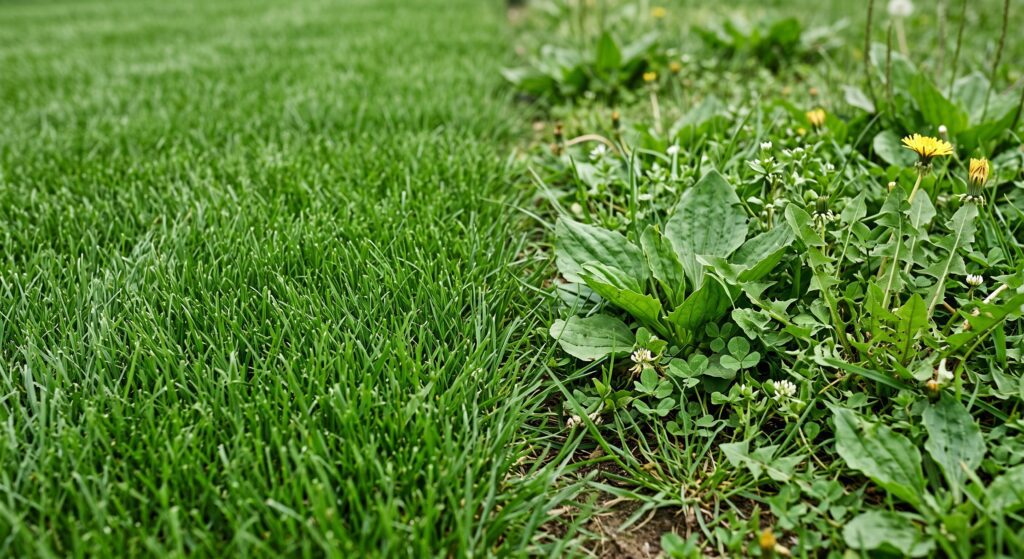
Broadleaf weeds have wide, net-veined leaves and often distinctive flowers clover, dandelion, and chickweed are classic examples. Grassy weeds, like crabgrass, have blade-like leaves that resemble your lawn grass itself, and need a genuinely different control approach. Confusing the two is one of the most common reasons DIY weed control doesn’t work.
This guide covers how to identify broadleaf weeds correctly, the strategy behind effective control, and why lawn health not just treatment determines whether weeds keep coming back.
Broadleaf Weeds vs. Grassy Weeds: A Distinction Worth Getting Right
Summary: Broadleaf weeds have wide, net-veined leaves and are structurally different from your turf grass, making them relatively easy to spot, while grassy weeds like crabgrass closely resemble the surrounding lawn and are harder to identify and control. Broadleaf weed control Pakistan needs to start with confirming which category you’re actually dealing with.
- Broadleaf weeds: Wide leaves with a central vein and branching pattern, often flowering, structurally distinct from grass. Examples include clover, dandelion, and chickweed.
- Grassy weeds: Blade-like leaves that closely resemble turf grass, making them harder to spot visually. Crabgrass is the most commonly referenced example, and it is not a broadleaf weed despite sometimes being grouped with them informally.
⚠️ Common Client Mistake: Property owners frequently lump every unwanted lawn plant together as “weeds” and apply a single broadleaf-targeted treatment across the board. A selective broadleaf herbicide won’t effectively control a grassy weed like crabgrass, and using the wrong product type wastes time and money without solving the actual problem.
Why Broadleaf Weeds Establish in the First Place
Summary: Broadleaf weeds most commonly establish in thin, stressed, or bare patches of lawn where turf grass isn’t dense enough to outcompete them for light and space. Addressing turf density and overall lawn health is as important to long-term weed control as any direct treatment.
Weeds are opportunistic they establish where turf grass has weakened or thinned, whether from compaction, poor irrigation, mowing stress, or nutrient deficiency. A dense, healthy lawn naturally crowds out most broadleaf weed seedlings before they can establish.
💡 Our Experience: On lawn maintenance programs across DHA and Bahria Town developments, we’ve consistently found that properties combining proper soil conditioning and mowing practice covered in our organic lawn fertilizer guide and monsoon lawn care schedule show noticeably less broadleaf weed pressure than lawns treated for weeds in isolation without addressing overall turf health.
Integrated Approach: Cultural Practices That Reduce Weed Pressure
Summary: Correct mowing height, consistent irrigation, and adequate soil fertility all reduce broadleaf weed establishment by keeping turf dense and competitive these cultural practices should be the foundation of any weed control strategy, not an afterthought to chemical treatment. Weed control that ignores these fundamentals tends to need repeating every season.
- Mowing height: Cutting too short weakens turf density and opens space for weed seedlings to establish; maintaining an appropriate mowing height for your specific grass variety supports natural weed competition.
- Consistent irrigation: Both under- and over-watering stress turf and create openings for weed establishment; steady, appropriate watering supports dense, competitive grass growth.
- Soil fertility and structure: Nutrient-deficient or compacted soil weakens turf, covered in depth in our organic fertilizer and lawn drainage guides.
🛠️ Professional Tip: Before reaching for any herbicide, look at where the weeds are concentrated in your lawn if they’re clustered in specific thin or bare patches rather than spread evenly, the underlying issue is likely turf density in that specific area, and fixing that will do more long-term good than repeated spot treatment.
Understanding Pre-Emergent and Post-Emergent Control
Summary: Pre-emergent herbicides target weed seeds before they germinate, while post-emergent herbicides treat weeds that have already established using the wrong type for your situation, or applying at the wrong time, significantly reduces effectiveness. Timing relative to weed germination and growth stage matters as much as product selection.
- Pre-emergent control: Applied before weed seeds germinate, forming a preventive barrier rather than treating existing growth; timing needs to align with your region’s typical weed germination period.
- Post-emergent control: Applied to weeds that have already emerged and are actively growing; effectiveness is generally higher on younger weeds than on mature, established ones.
- Selective vs. non-selective herbicides: Selective products target specific weed types (like broadleaf weeds) while leaving turf grass unharmed when applied correctly; non-selective products kill any plant they contact and require careful, targeted application to avoid turf damage.
⚙️ What We Learned in the Field: We’ve seen post-emergent broadleaf treatments applied to well-established, mature weeds with limited results, simply because control becomes progressively harder the longer a weed has been established catching broadleaf weeds early, while they’re still young, consistently produces better outcomes than waiting until an infestation is visually obvious.
Manual Removal: When It Works and When It Doesn’t
Summary: Hand-pulling can be effective for isolated broadleaf weeds, particularly those without deep taproots, but incomplete root removal on deep-rooted weeds like dandelion often leads to regrowth. Manual removal works best as a complement to good turf density practices, not as a standalone strategy for widespread infestation.
- Effective for isolated weeds: Spot removal works well when weeds are scattered rather than widespread across the lawn.
- Root completeness matters: Deep-taprooted weeds regrow if the root isn’t fully removed, making careful, complete extraction important.
- Not practical for widespread infestation: Manual removal alone struggles to keep pace with a significant, established weed population across a large lawn area.
A Note on Herbicide Product Selection
Summary: Specific herbicide product and dosage recommendations should come from the product label or a licensed agricultural input supplier familiar with what’s currently registered and available in Pakistan, rather than a general guide. This article focuses on strategy and timing principles rather than naming specific products.
We’ve deliberately kept this guide focused on identification and strategy rather than recommending specific herbicide products or exact application rates always follow the product label instructions for whatever selective or non-selective herbicide you use, and consult a licensed agricultural input supplier if you’re unsure which product fits your specific weed and turf situation.