Skip to content
Hardscape Cost Pakistan: What Actually Drives the Price
Summary: Hardscape cost in Pakistan is determined by material choice, labor and sub-base preparation, drainage complexity, and site accessibility not a single flat rate per square foot. A written, itemized quote that separates these components is the only reliable way to compare contractors or budget accurately.
Why a Single “Average Price” Doesn’t Work for Hardscape
If you’re researching hardscape cost in Pakistan, you’ve probably noticed that most sources either avoid giving numbers entirely or offer a single flat rate that doesn’t hold up once you get an actual site quote.
That’s because hardscape cost isn’t really about the material it’s about what’s happening underneath it. Two driveways that look identical on the surface can have very different costs depending on soil compaction needs, slope, and drainage complexity.
At Design & Concept Studio, 13 years of pricing and executing hardscape projects across DHA City Karachi, DHA Lahore, and Bahria Town has shown us that the biggest source of client frustration isn’t the price itself it’s an unclear quote that doesn’t explain what’s actually driving the number.
What Actually Determines Hardscape Cost
Summary: Hardscape cost in Pakistan is driven primarily by material selection, labor and sub-base preparation, drainage complexity, and site access with sub-base and drainage work frequently costing as much as the visible surface material. Understanding these four drivers lets you evaluate a quote instead of just reacting to a total number.
1. Material Selection
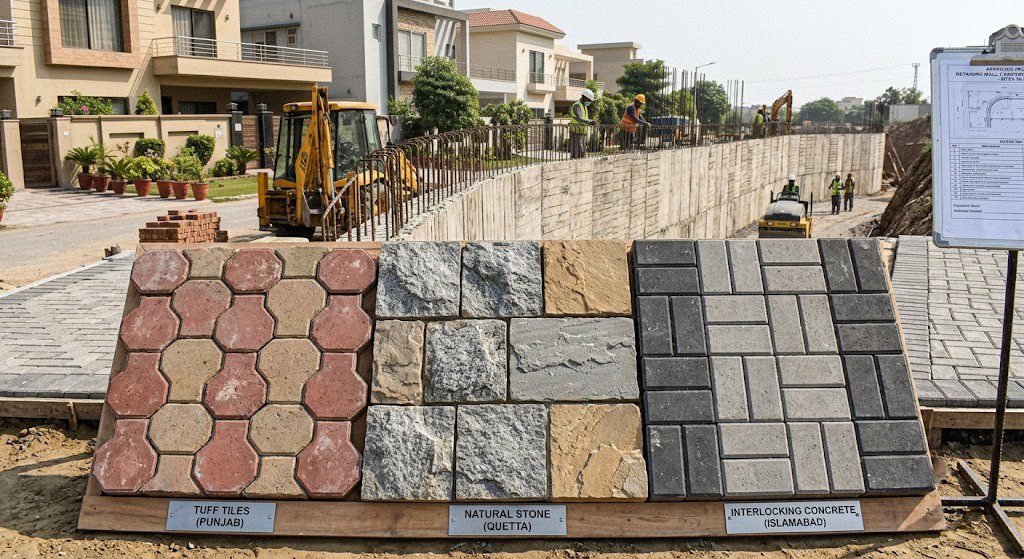
Natural stone, concrete pavers, and brick carry different material costs, covered in detail in our durable hardscape materials guide. Material is often the most visible cost line but rarely the largest.
2. Labor and Sub-Base Preparation
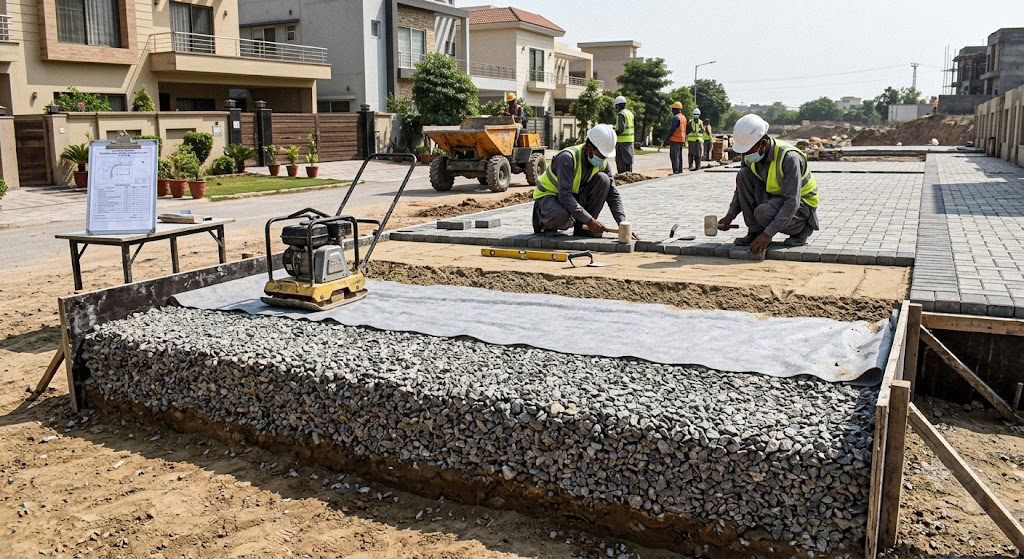
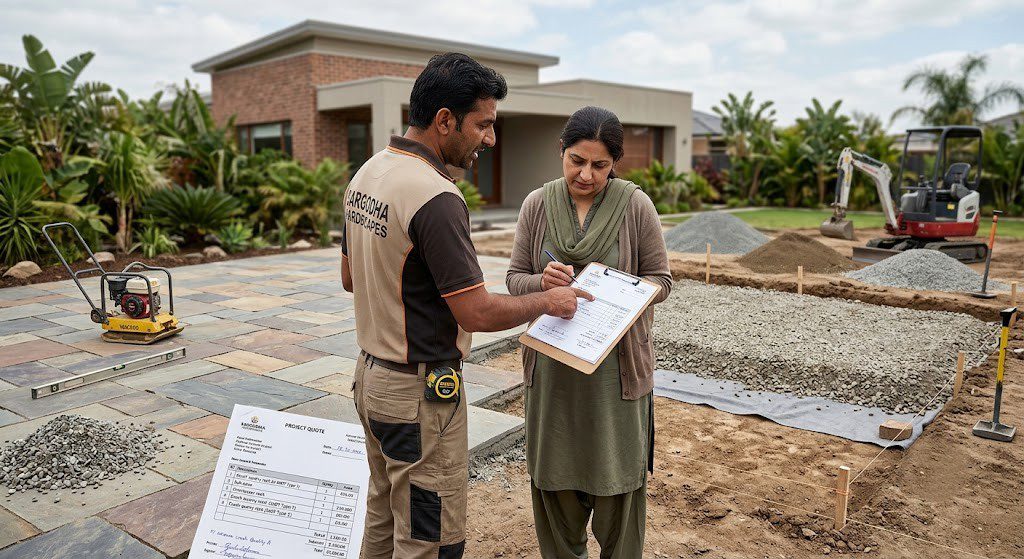
Excavation, compaction, and sub-base engineering require skilled labor and time. This is the step most often underquoted by informal contractors, and the step most responsible for premature cracking when skipped.
⚠️ Common Client Mistake: Comparing two quotes purely on their total number without confirming whether both include full sub-base preparation. A quote that skips proper compaction will always look cheaper upfront and cost more within two years when the surface fails.
3. Drainage Complexity
Sites requiring slope correction, drainage channel integration, or retaining wall weep holes carry additional engineering and labor cost but this is also the work that prevents monsoon-season failures.
4. Site Access and Existing Conditions
Difficult site access, existing structures requiring removal, or challenging soil conditions all affect labor time and, therefore, total project cost.
💡 Our Experience: On several DHA City Karachi and Bahria Town projects, we’ve had to explain to clients why a sloped plot costs more to pave than a flat one nearby the material is identical, but the grading and drainage work behind it is not.
Cost Drivers by Hardscape Element
Summary: Different hardscape elements carry different cost structures driveways are driven by load-bearing sub-base needs, patios by material and finish choice, and retaining walls by structural engineering complexity. Understanding which driver dominates your specific project helps you ask more informed questions during a quote.
| Hardscape Element | Primary Cost Driver | Secondary Cost Driver |
|---|---|---|
| Driveways | Sub-base compaction for vehicle load | Material selection |
| Patios/Decks | Material and finish selection | Drainage integration |
| Retaining Walls | Structural engineering and drainage weep holes | Wall height and soil pressure |
| Pathways | Sub-base and slope grading | Material selection |
| Boundary Walls | Structural requirements | Material and finish |
🛠️ Professional Tip: When comparing quotes for a driveway specifically, ask each contractor to itemize sub-base preparation separately from surface material. This single question reveals more about long-term durability than the headline price does.
Why Two Similar-Looking Quotes Can Have Very Different Prices
Summary: Two hardscape quotes for what looks like the same project can differ significantly because one accounts for proper sub-base compaction, drainage integration, and structural engineering, while the other doesn’t. The cheaper quote is often cheaper because it’s leaving out work that determines whether the hardscape lasts.
- Scope inclusion: Does the quote include excavation and sub-base preparation, or just surface installation?
- Drainage integration: Is slope grading and water management engineered into the design, or an afterthought?
- Material specification: Is the exact material grade and thickness specified, or left vague?
- Warranty and maintenance terms: Does the quote include any post-installation guarantee on structural work?
⚙️ What We Learned in the Field: We’ve been called in to repair multiple driveways and patios in Bahria Town and DHA developments where the original quote was the lowest of three bids and the reason it was lowest was that sub-base preparation had been skipped entirely.
How to Evaluate a Hardscape Contractor’s Quote
Summary: A trustworthy hardscape quote should be written, itemized by scope (design, sub-base, materials, drainage, finishing), and based on an actual site visit rather than a verbal estimate over the phone. If a contractor gives you a total price without visiting your site, treat that number as unreliable.
- Insist on a site visit before final pricing — soil, slope, and access conditions can’t be accurately assessed remotely.
- Request an itemized, written scope — separating design, sub-base preparation, materials, drainage, and finishing.
- Ask what’s excluded — permit fees, existing structure removal, or drainage tie-ins are sometimes left out of headline quotes.
- Clarify warranty terms — structural work like retaining walls should carry some form of workmanship guarantee.
Long-Term Cost: Why Cheap Hardscape Often Costs More
Summary: Hardscape installed without proper sub-base or drainage engineering frequently needs partial or full replacement within one to two years, meaning the “cheaper” option often ends up costing more once repair or redo work is factored in. Evaluating cost over the lifespan of the installation, not just the upfront number, gives a more accurate picture.
- Redo costs: Repairing a cracked or sunken surface typically requires excavating and redoing sub-base work anyway cost you’d have paid once if done correctly the first time.
- Water damage costs: Poor drainage integration can lead to foundation seepage or boundary wall damage, adding repair costs well beyond the hardscape itself.
- Maintenance costs: Properly sealed and engineered surfaces require less frequent maintenance than rushed installations prone to cracking and staining.