Skip to content
Hardscape Drainage: How Grading, Leveling, and Slope Actually Work
Summary: Hardscape drainage relies on a layered sub-base system, correctly compacted, and a calculated surface slope that directs water away from structures rather than letting it pool. Most patio, driveway, and pathway failures trace back to skipped or incorrect drainage engineering not the paving material itself.
The Problem Is Almost Never the Material
When a patio cracks, a driveway sinks, or water pools where it shouldn’t, most people blame the material. In our 13 years executing hardscape across DHA City Karachi, DHA Lahore, and Bahria Town, the material is rarely the actual cause.
Hardscape drainage the system of grading, sub-base layering, and slope that sits beneath and around every paved surface — is what determines whether that surface survives its first monsoon season or fails within a year.
This guide breaks down exactly how hardscape drainage works, in plain terms, so you can evaluate whether your own project (or a contractor’s plan for it) is actually built to last.
Why Hardscape Drainage Fails More Often Than Materials Do
Summary: Hardscape drainage failure is almost always caused by inadequate sub-base compaction, missing slope calculation, or skipped drainage integration not by using a “bad” material. Even premium stone or pavers will crack and shift if the layers beneath them aren’t engineered correctly.
Water that isn’t directed away from a paved surface doesn’t just disappear it settles into whatever gaps or weak points exist beneath it. Over repeated monsoon cycles, that settling causes cracking, sinking, and surface unevenness.
⚠️ Common Client Mistake: Homeowners frequently assume that a flat plot doesn’t need drainage planning, since there’s no visible slope to worry about. In reality, flat plots are often at higher risk of pooling, because there’s no natural fall to rely on the slope has to be engineered in, not assumed.
What’s Actually Underneath a Properly Built Hardscape Surface
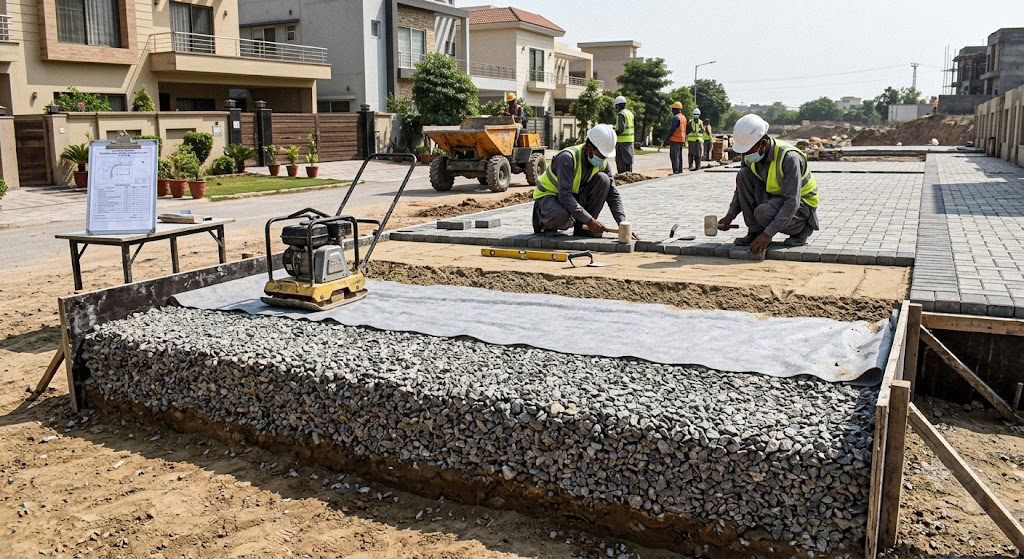
Summary: A properly built hardscape surface is a layered system compacted sub-base, gravel base, leveling sand, and the surface material itself with each layer serving a specific structural and drainage function. Skipping or under-building any single layer is what causes premature failure.
1. Excavation and Sub-Base Compaction
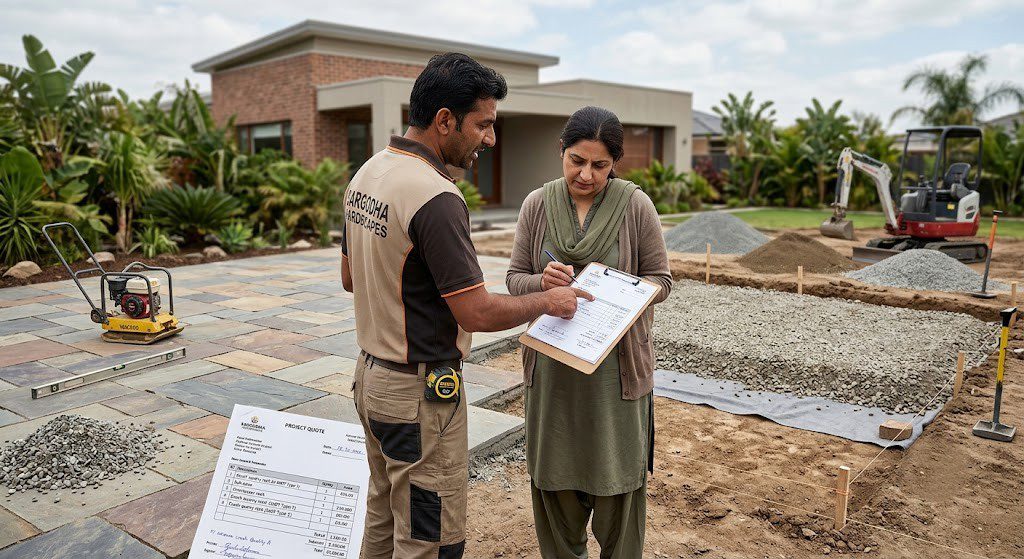
The ground beneath the future surface is excavated and compacted to create a stable, uniform foundation this is the single most commonly skipped or rushed step by unqualified contractors.
2. Gravel Base Layer
A layer of compacted gravel sits above the sub-base, providing structural support and allowing water to drain downward rather than pooling at the surface.
3. Geotextile Fabric
In many installations, a permeable fabric layer separates the gravel base from the soil beneath, preventing soil migration into the gravel over time and preserving drainage function.
4. Leveling Sand
A thin, precisely graded sand layer sits just beneath the surface material, allowing for fine leveling and even settling of individual pavers or stones.
5. Surface Material
The visible paving material stone, pavers, or brick sits on top of this entire system, but it’s only as durable as the layers supporting it.
💡 Our Experience: On several DHA City Karachi projects, we’ve excavated failed patios installed by other contractors and found gravel base layers less than half the recommended depth, with no geotextile fabric at all. The surface material was fine the system underneath it was never built correctly.
Slope: The Most Overlooked Factor in Hardscape Drainage
Summary: Paved hardscape surfaces need a calculated slope to direct water away from structures and toward proper drainage points without it, even a well-built sub-base won’t prevent pooling. A slope that’s too flat fails to move water, while a slope that’s too steep creates its own erosion and usability problems.
- Direction matters as much as degree — slope has to be calculated to move water away from your home’s foundation and boundary walls, not just “downhill” in a general sense.
- Flat plots need engineered slope, not assumed slope — this is the category of plot most likely to be skipped by contractors who don’t grade properly.
- Consistent slope across the full surface — uneven or interrupted slope creates localized pooling even if the overall direction is correct.
🛠️ Professional Tip: Walk your property after a heavy rain before starting any hardscape project. Note exactly where water currently pools or flows this is the single most useful piece of information you can give a contractor before design work begins.
When You Need a French Drain, Catch Basin, or Drainage Channel
Summary: Standard surface slope handles most drainage needs, but low-lying areas, heavy runoff zones, or plots with limited natural fall often need additional drainage infrastructure like French drains, catch basins, or dedicated drainage channels. These aren’t universal requirements they’re solutions for specific site conditions.
| Solution | What It Does | When It’s Needed |
|---|---|---|
| French Drain | A gravel-filled trench with a perforated pipe that redirects underground water | Persistent water table or subsurface moisture issues |
| Catch Basin | A collection point that gathers surface runoff and channels it to a drainage line | Low points where water naturally collects |
| Drainage Channel | A surface-level channel, often near driveways or patio edges, that captures and redirects runoff | High-runoff areas like driveway entrances |
⚙️ What We Learned in the Field: On several Bahria Town and DHA Gujranwala projects with lower-lying rear yards, standard slope grading alone wasn’t enough to prevent seasonal pooling a properly placed catch basin resolved what three separate attempts at re-grading hadn’t fixed.
Erosion Control and Long-Term Drainage Maintenance
Summary: Even correctly engineered hardscape drainage benefits from periodic maintenance clearing debris from drainage channels, checking for joint erosion, and confirming gravel base integrity hasn’t shifted over time. Drainage systems are durable, but they aren’t maintenance-free.
- Clear debris from drainage channels and catch basins seasonally, particularly before monsoon season.
- Check paver or stone joints for erosion or gaps that could indicate sub-base settling underneath.
- Monitor slope-critical areas near foundations and boundary walls for any signs of new pooling after several seasons.
⚠️ Common Client Mistake: Property owners often assume that once hardscape drainage is installed, it needs zero further attention. Debris buildup in drainage channels and catch basins is one of the most common and easiest to prevent causes of drainage system failure over time.