Lawn Drainage Solutions Pakistan: The Monsoon-Proof Engineering Guide
Summary: Effective lawn drainage solutions Pakistan homeowners can rely on combine precise landscape grading, subsurface perforated piping, and soil-specific remediation not surface patches. Design & Concept Studio engineers drainage systems around Pakistan’s actual soil conditions and monsoon rainfall intensity, not generic templates.
Introduction: Why Your Lawn Floods Every Monsoon Season
If you’re searching for lawn drainage solutions Pakistan properties actually need, you’ve likely already watched water pool across your grass for two or three days straight while your neighbor’s lawn drained overnight. That difference is not luck. It is engineering.
Standing water isn’t just an eyesore. It suffocates turf roots, invites mosquito breeding, and over repeated monsoon cycles destabilizes soil beneath pathways and boundary walls.
Homeowners across DHA Karachi, Bahria Town, and Gujranwala routinely tell us the same story: a previous contractor added topsoil, replanted grass, and called it fixed. Six months later, the same patch drowns again.
Design & Concept Studio has spent 13 years diagnosing and rebuilding drainage systems across Pakistan’s most demanding residential and commercial sites. This guide walks through exactly why your lawn waterlogs, what real solutions look like, and how to evaluate whether a fix is engineered or cosmetic.
What Causes Poor Lawn Drainage in Pakistan?
Poor lawn drainage in Pakistan is caused by a combination of compacted subsoil, incorrect surface grading, and monsoon rainfall intensity that exceeds what unmodified native soil can absorb. Most residential plots were graded for construction access, not water flow.
Soil Compaction and Permeability Loss
Construction machinery compacts subsoil during the build phase. This collapses the pore spaces that would normally let rainwater percolate downward.
- Clay-heavy soils (common in Punjab and interior Sindh): retain water and expand when saturated, worsening surface pooling.
- Reclaimed coastal fill (common in parts of Karachi): often has inconsistent permeability layers left over from land development.
- Sandy-silt mixes: drain faster but erode quickly under heavy monsoon flow if unstabilized.
Landscape Grading Errors
Many plots are graded flat, or worse, sloped toward the house or boundary wall rather than away from it. This is the single most common flaw we find when correcting other contractors’ work.
⚠️ Common Client Mistake: Assuming grass alone will absorb monsoon rainfall. Turf slows runoff it does not replace an engineered grading and piping system.
Rainfall Intensity vs. Absorption Capacity
Pakistan’s monsoon delivers concentrated rainfall in short windows, frequently exceeding 50-100mm in a single session in urban centers. Native, unmodified soil simply cannot absorb that volume fast enough without engineered assistance.
Core Lawn Drainage Solutions for Pakistani Monsoon Conditions
The most reliable lawn drainage solutions Pakistan properties need combine surface grading correction, subsurface piping, and targeted soil amendment deployed together, not as isolated fixes.
1. Landscape Grading and Surface Slope Correction
Surface grading is the foundation of every functional drainage system. Without correct slope, every other intervention becomes a patch, not a solution.
- Standard slope target: a minimum of 2% gradient (roughly 5cm drop per 3 meters) directing water away from structures.
- Swales: shallow, grassed channels engineered to redirect surface runoff toward a designated exit point.
- Positive drainage zones: re-contoured planting beds that intentionally absorb and slow runoff before it reaches hardscape.
💡 Our Experience: On a Bahria Town residential project, we corrected a lawn that had been graded flat by the original developer. A 2.5% slope adjustment alone eliminated 70% of the pooling before we even installed piping.
2. Subsurface Drainage: French Drains and Perforated Pipe Systems
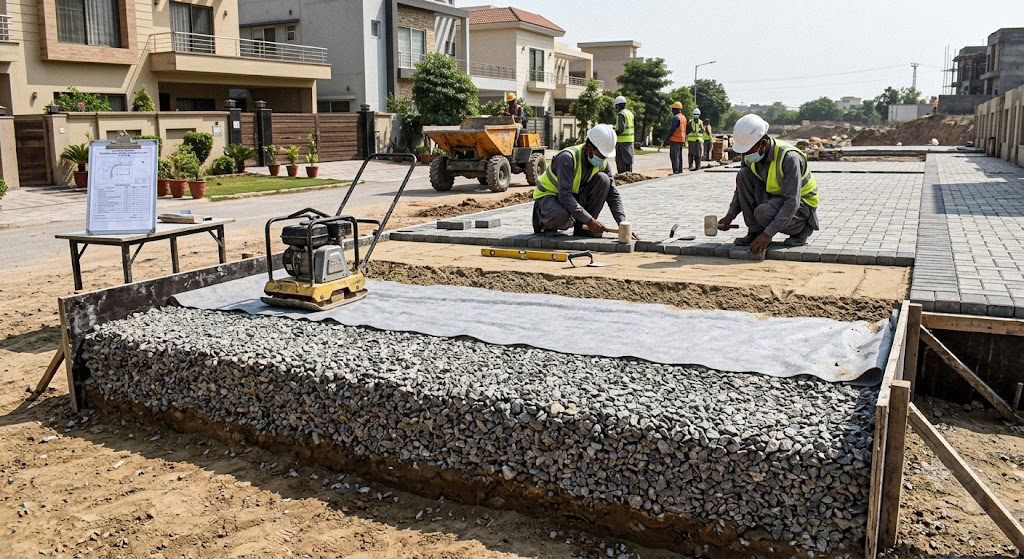
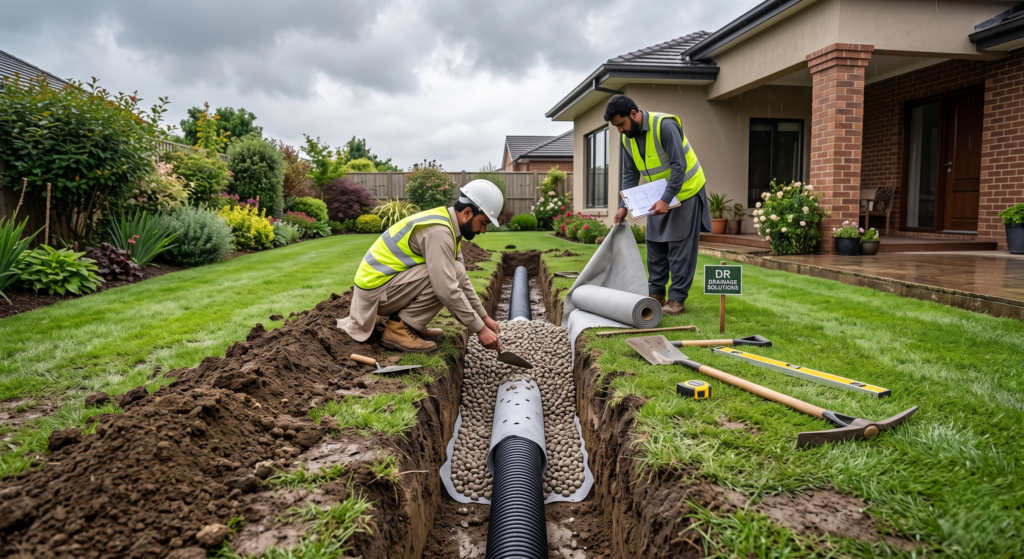
A French drain is a gravel-filled trench containing a perforated drainage pipe that channels subsurface water away from saturated zones. This is the core engineered fix for chronic waterlogging.
How it works:
- A trench is cut along the water’s natural collection path.
- A perforated pipe is laid at a calculated gradient (typically 1-2% slope minimum).
- The pipe is wrapped in geotextile fabric to prevent silt clogging.
- Gravel backfill allows rapid water entry into the pipe.
- The system discharges into a catch basin, channel drain, or municipal stormwater connection.
⚙️ What We Learned in the Field: French drains absolutely work in Pakistani clay soils the myth that they’re a “Western-only” solution is false. What changes is trench width and gravel grading; clay-heavy sites need wider gravel beds to compensate for slower lateral percolation.
3. Catch Basins and Channel Drains
Catch basins collect surface water at low points and route it into the underground piping network. Channel drains are used along driveways, patios, and hardscape edges where sheet flow needs interception.
| Drainage Component | Best Used For | Typical Placement |
|---|---|---|
| Catch Basin | Collecting pooled water at low points | Lawn depressions, corner drainage zones |
| Channel Drain | Intercepting sheet flow off hardscape | Driveway edges, patio perimeters |
| French Drain | Subsurface water table relief | Along boundary walls, behind retaining walls |
| Dry Well | Localized deep percolation | Areas with better subsoil permeability |
4. Soil Remediation for Long-Term Permeability
Piping alone doesn’t fix soil that can’t absorb water. Long-term lawn health requires restoring permeability.
- Core aeration: mechanically relieves compaction, especially post-construction.
- Organic matter amendment: improves clay soil structure and water infiltration rate over 1-2 growing seasons.
- Sand-based topdressing (in select cases): improves surface permeability without disrupting subsurface stability.
5. Erosion Control Along Slopes and Channels
Monsoon rainfall on graded slopes without stabilization causes soil erosion, undermining both drainage channels and turf health.
- Root-mat turf varieties for slope stabilization.
- Retaining edges along constructed swales.
- Mulched planting beds to slow runoff velocity before it reaches drainage inlets.
Rainwater Management: Where Does the Water Actually Go?
A complete lawn drainage system must have a legitimate discharge point rainwater has to go somewhere that doesn’t simply relocate the flooding problem to a neighboring plot or public street.
Discharge Options We Engineer Around
- Municipal stormwater connections, where civic infrastructure permits it (common in planned developments like DHA sectors).
- On-site retention/dry wells, allowing gradual percolation without overwhelming external systems.
- Rain gardens, which double as landscape features while managing overflow.
🛠️ Professional Tip: Before finalizing any drainage plan, we run a percolation test timing how quickly water absorbs into test pits at multiple points on the property. This single step prevents the single most expensive drainage design mistake: undersizing the system for actual soil conditions.
Cost Reality: Engineered Drainage vs. Repeated Cosmetic Fixes
Homeowners frequently compare the upfront cost of engineered drainage against the recurring cost of “cheap” annual fixes without realizing the second option compounds.
Common recurring cosmetic-fix costs (documented pattern across client sites):
- Re-sodding damaged turf after each monsoon season.
- Repeated soil top-ups that settle again within a year.
- Structural repair to boundary walls or pathways undermined by chronic saturation.
One-time engineered drainage investment:
- Grading correction.
- French drain / piping network installation.
- Soil remediation.
- Typical payback horizon: most clients recover the cost differential within 2-3 monsoon seasons through eliminated re-sodding and repair costs.
How to Know If Your Lawn Needs Professional Drainage Intervention
Poor lawn drainage in Pakistan typically requires professional engineering not DIY fixes when standing water persists beyond 24 hours, when the same area floods every season despite topsoil additions, or when nearby structures show water damage.
Signs you need an engineered system, not another patch:
- Water standing more than 24-48 hours after rainfall stops.
- Recurring dead or yellowing turf patches in the same location each year a sign of root rot from prolonged saturation.
- Visible erosion channels forming across your lawn during heavy rain.
- Water pooling against your boundary wall or foundation a structural risk, not just a landscaping issue.
- A previous “fix” that failed within one monsoon cycle.
FAQs on Lawn Drainage Solutions in Pakistan
Do French drains actually work in Pakistani clay soil? Yes. French drains work in clay-heavy soils when trench width and gravel grading are adjusted to compensate for slower lateral percolation a standard part of our design process.
How much slope does a lawn need for proper drainage? A minimum 2% gradient directing water away from structures is the standard baseline, though exact figures depend on soil type and plot size.
Can I fix lawn waterlogging without digging up my whole garden? In many cases, yes targeted French drain trenches and catch basin placement can resolve chronic wet spots without a full lawn overhaul.
How long does a professional drainage system last? A properly engineered system with correct pipe gradient and gravel backfill typically performs for 15-20+ years with minimal maintenance.
The Design & Concept Studio Standard
Lawn drainage solutions Pakistan properties need are not generic. Every site we assess gets a percolation test, a grading survey, and a soil-specific piping plan before a single trench is dug.
We’ve spent 13 years correcting both new installations and other contractors’ failed drainage work across DHA City Karachi, DHA Gujranwala, Bahria Town, Airlink, Dera Ismail Khan, and elite private estates nationwide.
If your lawn floods every monsoon, the fix isn’t more topsoil. It’s an engineered system built around your actual soil and slope conditions.
Ready to stop rebuilding your lawn every monsoon? Contact Design & Concept Studio for a site drainage assessment.